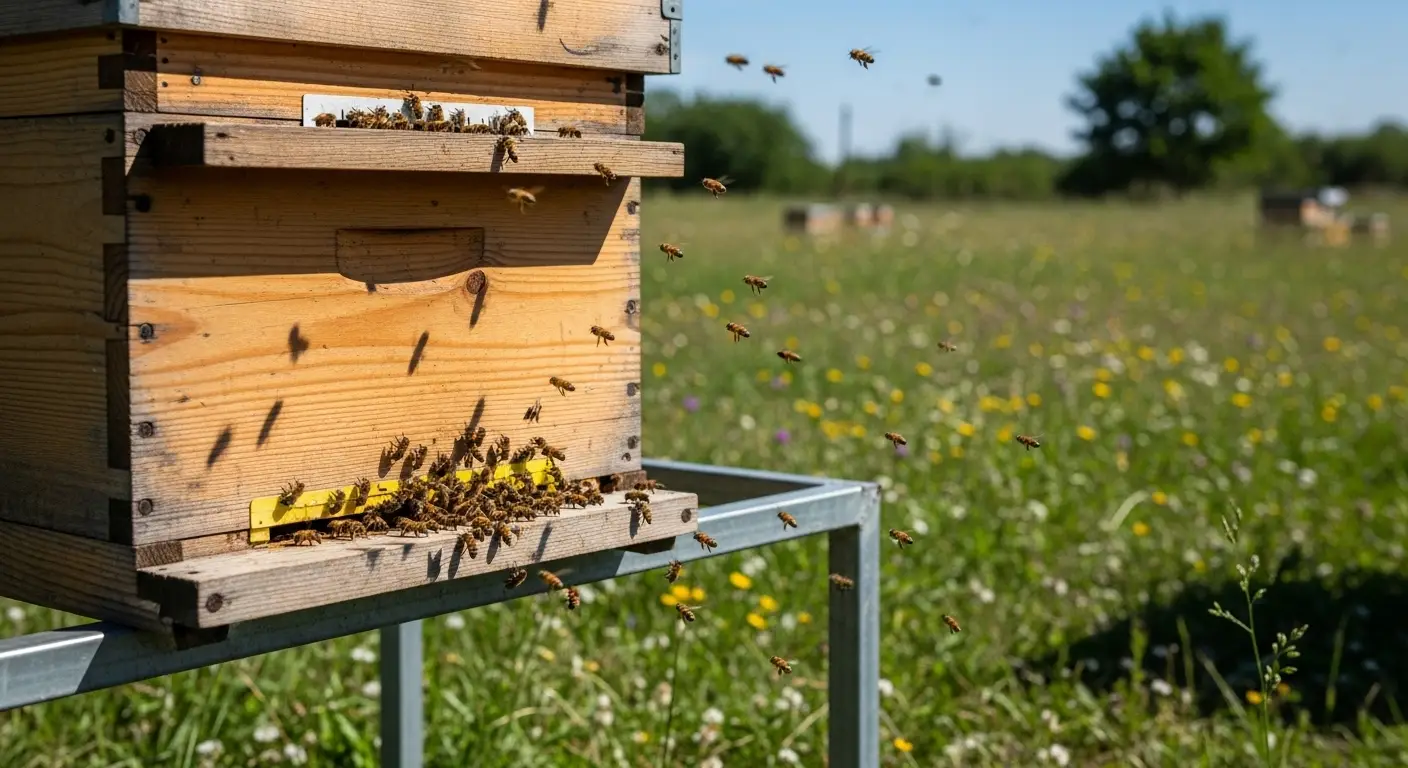
Dadant hive; is the largest volume hive model used in beekeeping, resembling Langstroth hives in working principle but distinguished from it by a deeper body structure and wide frame dimensions. Preferred especially in commercial beekeeping, this system allows strong colonies to develop without swarming and pass the winter months more comfortably thanks to its large brood chamber area.
The Dadant hive system was developed by the French-born American beekeeper Charles Dadant in the second half of the 19th century (1860s).
After immigrating to America, Charles Dadant examined the Langstroth hives, which were the revolutionary invention of the period, but realized that the brood chamber volume of these hives was insufficient to meet the full egg-laying capacity of a productive queen bee. According to Dadant, small hives limited the development of strong colonies and encouraged bees to swarm.
To solve this problem, Dadant deepened the brood chamber body and widened the frame dimensions while preserving Langstroth’s “bee space” principle. His design was later standardized with small revisions by the Swiss beekeeper Blatt (Dadant-Blatt) and became one of the indispensable models of commercial beekeeping, especially in Europe and America.
What Are the Features of the Dadant Hive?
The most distinct technical and structural features that distinguish the Dadant hive from other standard hives are as follows:
- Deep Brood Chamber Body: Unlike standard Langstroth hives, the brood chamber part of the Dadant hive is deeper (approximately 30-31 cm). This ensures the queen bee has a very wide egg-laying area on a single frame.
- Differently Sized Supers: While the brood chamber is deep and large, the honey supers added on top are generally shallower (half supers). In this way, the beekeeper can harvest without having to lift heavy supers.
- Wide Frame Capacity: They are generally produced as 10, 11, or 12 frames. This large volume allows the colony to grow without becoming congested.
- Fixed Brood Chamber Principle: Since the brood chamber volume is very large, frame exchange is generally not done between the brood chamber and super layers; brood is stored below, honey above.
Dadant Hive Dimensions and Technical Specifications
The most widely used standard in the Dadant hive system today is the “Dadant-Blatt” model. The standard technical dimensions are as follows:
- Brood Chamber (Body) Height: While a standard Langstroth hive is 24 cm deep, the Dadant brood chamber is approximately 31 cm high.
- Frame Dimensions:
- Brood Frame: 435 mm x 300 mm (Wide and deep surface for uninterrupted laying).
- Super Frame: 435 mm x 160 mm (Easy to carry when full of honey).
- Number of Frames: Although original Dadant hives were generally 12-frame, 10-frame models are also common for portability.
Differences Between Dadant Hive and Other Hive Models
To understand the difference of the Dadant hive, it is necessary to compare it with other common models:
- Skep Hive vs. Dadant: The skep hive has been almost abandoned in modern production. The Dadant hive offers detailed management of every stage of the colony.
- Langstroth Hive vs. Dadant: The Langstroth hive consists of equal dimensions. While Langstroth is enlarged by “adding stories,” Dadant offers a “horizontally wide” volume.
- Nuc (Nucleus) Hive vs. Dadant: While nuc hives are used for splits; the Dadant hive is designed to house the strongest colonies.
- Thermo Hive vs. Dadant: The thermo hive is an insulated material name. Dadant is a size standard. You can find Dadant-type thermo hives in the market.
Advantages of the Dadant Hive
- Less Tendency to Swarm: The deep brood chamber offers an uninterrupted laying area. Since bees are not congested, the instinct to swarm decreases.
- Superior Overwintering Ability: Deep frames make it easier for the bee cluster to move upwards and reach honey stocks without crossing “dead space.”
- Easy Honey Harvest: Half supers are lighter, protecting the beekeeper’s back health.
- Single-Time Inspection: Maintenance time is shorter compared to double-story brood chamber systems.
Disadvantages of the Dadant Hive
- Weight: The Dadant brood chamber becomes quite heavy, making it more suitable for stationary beekeeping.
- Frame Incompatibility: Brood chamber frames and super frames are of different sizes.
- Equipment Supply: Finding parts suitable for Dadant dimensions can be more difficult compared to Langstroth standards.
Field View on Dadant Hive Beekeeping: Real Experiences of Master Beekeepers
The “Single Brood Chamber” Doctrine and Uninterrupted Brood Area
- Uninterrupted Dance: Dadant’s frame offers the queen a massive, single-piece canvas. The queen lays in spirals without being divided by bars.
- Explosive Spring Development: Dadant colonies grow at an “explosive” speed in the spring because the system works by itself without “reversing” stories.
Overwintering Performance: The Insurance of Cold Climates
“I’ve seen the cluster split in two in my Langstroth hives and freeze. In my Dadant hives, the cluster stays as a single piece like a huge ball.” – (Master beekeeper comment)
Dadant vs. Langstroth: Field Comparison
| Feature | Double Story Langstroth | Single Story Dadant | Field Effect |
| Brood Area | Divided | Uninterrupted | Regular laying. |
| Winter Insulation | Risk of heat loss | Stable heat | Minimizes heat loss. |
| Weight | ~30-35 kg | ~45-50 kg | Exceeds single person limit. |
The Other Side of the Coin: “Bee Friendly, Beekeeper Enemy”
If you don’t have a crane or hive lift, the Dadant hive “won’t budge.” It is generally suitable for stationary beekeeping or large enterprises with mechanical systems.
Real Questions and Experiences from the Field
Is swarming control difficult?
Yes, the hive is very heavy and you have to pull huge frames one by one. We prevent swarming by keeping the queen young.
Will I have equipment trouble?
Yes, finding Dadant foundation can be difficult. If you don’t have a large supplier, don’t deviate from the standard in your region.
Does the Dadant hive really increase honey yield?
Indirectly, yes. Strong colonies make honey. My observation is that Dadant colonies stock 20-30% more.
Is there an advantage in Varroa control?
Yes, we can cut off the drone strip at the bottom of the deep frame to reduce the Varroa population biotechnicaly.
I have back pain, can I use Dadant?
Yes, by using a “Hybrid System.” The brood chamber is Dadant (fixed), and the supers on top are light Langstroth boxes.
Who is Dadant Suitable For?
- Ideal User: Professionals who do stationary beekeeping in regions with harsh winters.
- Stay Away: Migratory beekeepers who constantly move hives manually and those with back problems.