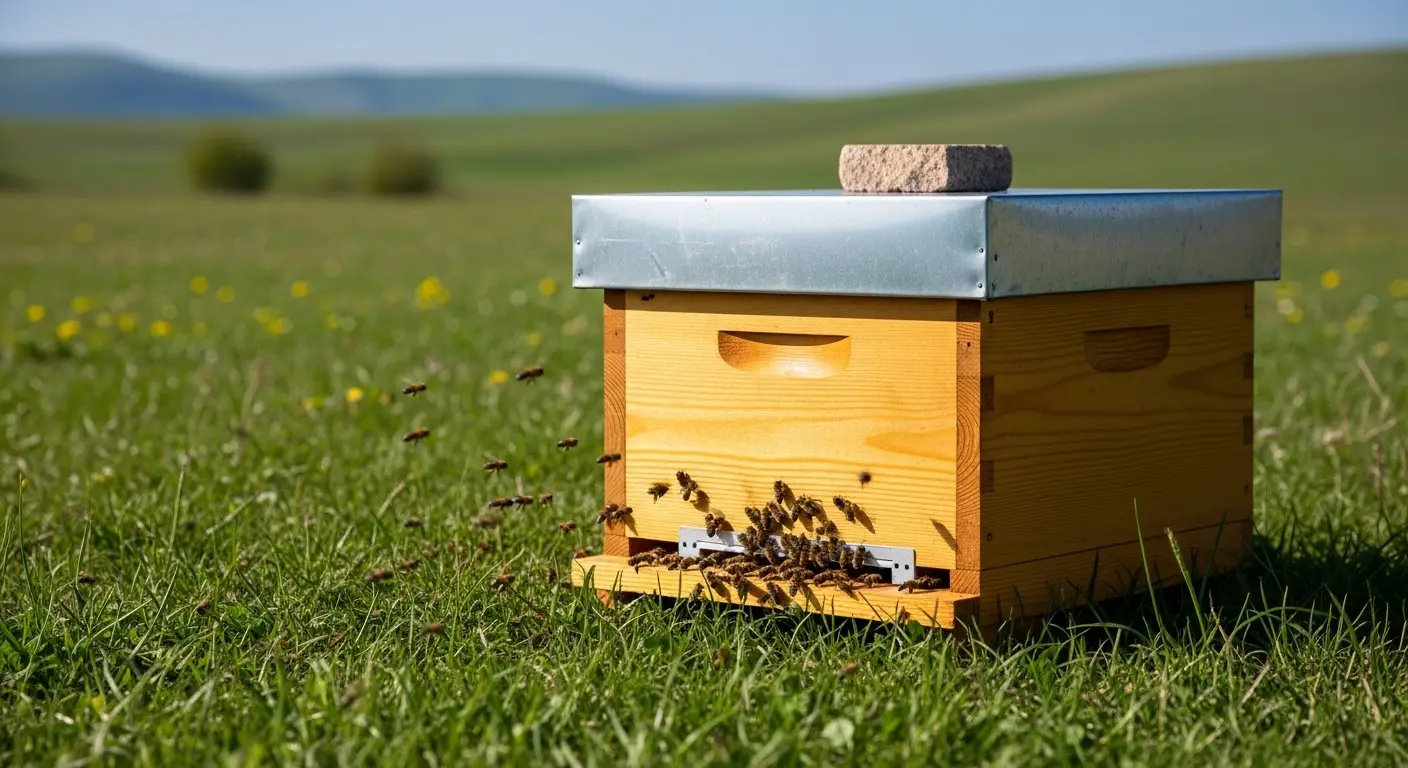
Nuc Hive: It is a hive type possessing all the technical capabilities offered by standard 10-frame bee hives, but achieved a more compact structure usually with a 5-6 frame capacity. Thanks to its narrow internal volume, it allows weak colonies to strengthen rapidly by preserving heat more easily; with its compartmentalized design, it offers a professional solution especially for queen bee production and colony splitting operations.
What Purposes is the Nuc Hive Used For?
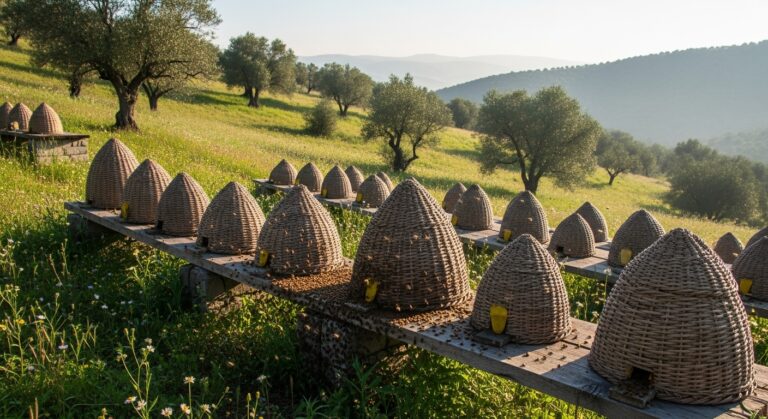
In modern beekeeping, every bee hive serves a different strategic purpose. Unlike fixed-structure methods such as the traditional skep hive, nuc hives provide operational flexibility and play a critical role in the following areas:
- Queen Production and Mating: Its small volume ensures that young queen bees can easily find the hive upon returning from the mating flight and that the colony accepts the queen faster.
- Colony Splitting (Artificial Swarm): “Nucleus colonies” (nucs) taken from strong hives in the spring are developed here.
- Bee Transport: Thanks to its light structure, it is the safest transport unit when selling bees or in migratory beekeeping.
- Swarm Catching: It provides great convenience thanks to its lightness for collecting swarms that settle in difficult places like tree branches.
Nuc Hive Dimensions and Technical Details
In beekeeping, equipment standards are of vital importance for sustainable management. Nucs must be designed to be compatible with standard hive parts.
Nuc hive dimension: It is a 5 or 6-frame hive type that is usually half the width of a standard Langstroth hive (approx. 23-25 cm), but possesses the exact same technical measurements as a standard hive in terms of depth and frame lug allowance.
The technical advantages provided by these dimensions are as follows:
- Frame Transfer: You can place a brood frame taken from a standard hive directly into the nuc without any cutting operation. If you are using a Dadant hive, your nuc must also be suitable for this depth.
- Entrance Hole: To prevent robbing, the flight entrance is kept much narrower compared to standard hives or adjustable apparatuses are used.
Material Selection: The Difference Between Wood, Styrofoam, and Thermo Nucs
The material from which the hive is produced directly affects thermal insulation, moisture balance, and the colony’s development speed:
- Thermo Hive Technology: Thermo hive type nucs block the cold in winter and excessive heat in summer. Colony development is more stable in these hives.
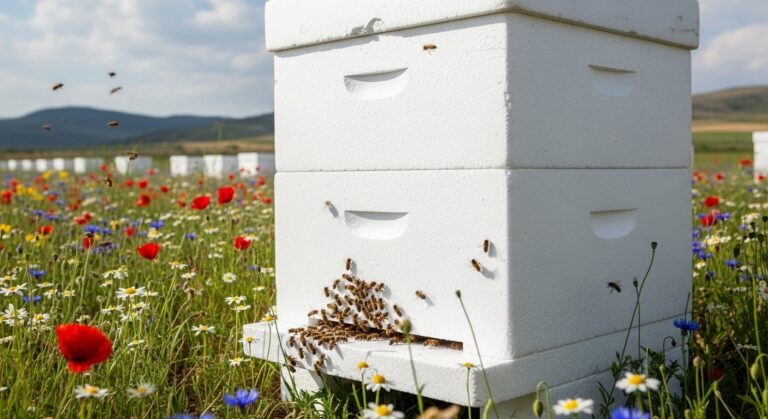
- Styrofoam Hive Option: Styrofoam hive models are known for their lightness and strong thermal insulation. They are frequently preferred for queen bee rearing.
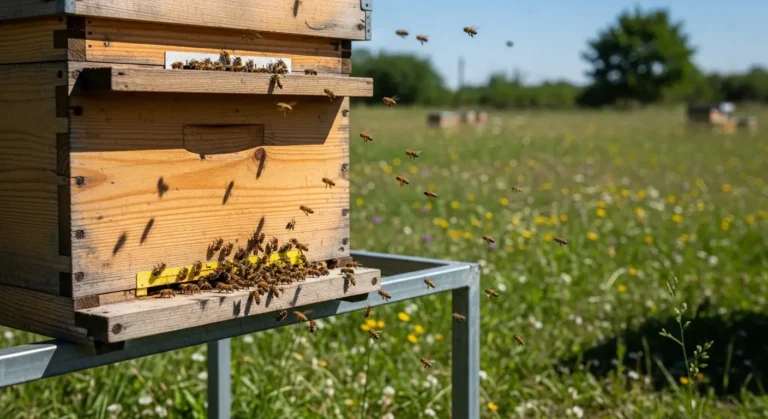
- Wooden Nucs: Allows the bee to breathe with its natural structure and balances humidity.
Advantages Provided to the Beekeeper by the Nuc Hive
Unlike large-volume hives, nucs work on the principle of “narrow space efficiency”:
- Rapid Spring Development: Bees stabilize the in-hive temperature in a narrow space by expending much less energy. Since there is no heat loss, the queen bee lays eggs more aggressively.
- Low Honey Consumption: Bees that do not exert excessive effort to keep warm use their winter honey stocks more frugally.
- Practicality: It takes up little space in the apiary and is light enough to be carried with one hand.
Overwintering Bees with Nuc Hive
Using nuc hives is a strategic method for weak colonies or spare queen bees to survive until spring. However, this process requires attention.
Pros and Cons of Overwintering
| Feature | Pros | Cons |
| Heat Management | The bee cluster preserves heat perfectly in a narrow space. | Excessive moisture may occur if ventilation is insufficient. |
| Feeding | The bee uses stock efficiently. | Frequent checks are required since storage space is limited. |
| Colony Safety | Weak bees are saved from collapsing. | The risk of early swarming arises in spring due to rapid development. |
Things to Consider in Overwintering
When overwintering with a nuc; it is mandatory to constantly check the food stock, position the Beehive in a place protected from the wind, and keep the top ventilation holes open to expel moisture. When the colony reaches 5-6 frames in the spring, it must be transferred to a standard hive without wasting time.
Nuc Hive Field Notes: Real Experiences and Warnings of Master Beekeepers
In beekeeping books, the nuc hive is referred to as a “splitting and queen production hive.” However, when we go down to the field, the situation is much more complex. Nuc hive selection is not just an equipment preference, but a strategic decision that determines the fate of the apiary.
The Big Fight in the Field: Which Material? (Facts and Complaints)
Thermo-Plastic Hives: “Practical but Hygiene Problematic”
- Disinfection Crisis: The biggest weapon against disease in beekeeping is scorching with a blowtorch. However, you cannot burn a plastic hive.
- Design Errors: It is frequently complained that worker bees struggle while passing through narrow excluders and refuse to go up to the honey super.
- Structural Fatigue: UV rays and day-night temperature differences lead to micro-cracks after the 2nd year.
Styrofoam (Foam) Nucs: “Cheap but Risky”
- Gnawing Issue: Bees perceive styrofoam as an “unnatural substance” and gnaw the walls.
- Pest Infestation: Mice and squirrels can easily bore through styrofoam in winter.
- Toxicity: Unsuitable paints or glues can release gas at in-hive temperatures (35°C).
Wooden Nucs: “The Indispensable Classic”
- A broken part is repaired cheaply at the local carpenter.
- It is 100% sterilized by burning with a flame in case of disease.
- The bee processes natural beeswax and propolis more healthily.
Master Usage Tactics: Nuc is Not Just “Splitting”
- Backup Station: 2 nucs for every 10 hives act as a “spare tire” to save strong hives that lose their queen.
- Aggressive Hive Rehabilitation: Larvae with gentle genetics are turned into queens in nucs to “tame” aggressive colonies.
- Combinable Frame Innovation: Using modular frame systems speeds up nuc development by 50%.
Most Frequent Deadly Mistakes Made in the Field
Daytime Feeding and Robbing
- Field Rule: Feeding must absolutely be done around sunset.
- Dosage: The daily dose is about “one tea glass” (150 ml). Excess syrup attracts robbers.
Wide Entrance Hole
It is impossible for a weak colony to defend a huge door. Entrance holes should be narrowed down to 1-2 cm.
Comparative Summary Table
| Feature | Wooden Nuc | Thermo-Plastic Nuc | Styrofoam Nuc |
| Hygiene/Sterilization | Excellent (Burnable) | Weak (Chemical required) | Very Weak |
| Durability | Very High (Repairable) | Medium (UV cracking) | Low (Fragile) |
| Thermal Insulation | Low | High | Very High |
| Cost | Medium | High | Very Low |
Field Answers to Frequently Asked Questions
How are plastic nucs cleaned in case of disease?
You have to soak them in hot water with bleach, as you cannot burn them with a blowtorch.
Is honey harvested from a nuc hive?
This is not the main purpose, but it is possible by adding a mini honey super.
Does a standard hive frame fit a nuc hive?
It definitely must fit. Frame transfer is the basis of nuc management.
How is bees gnawing on the styrofoam nuc prevented?
You must prime the inner surface with water-based, odorless paint or glue.
Should the bottom of the nuc be open or closed for overwintering?
It is vital that the bottom is screened (open) to expel moisture and prevent mold.